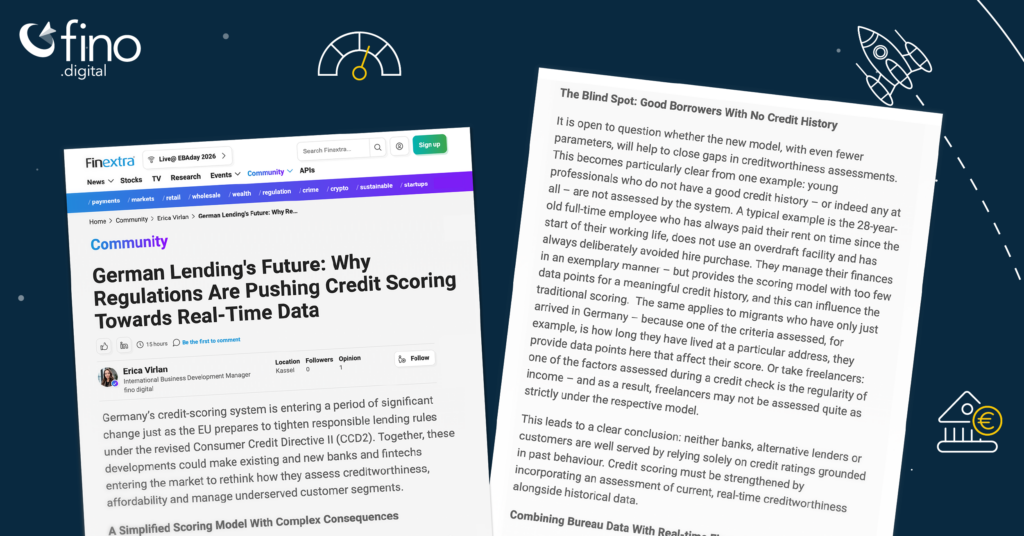
Germany’s credit markets are facing a two-fold upheaval: SCHUFA has significantly simplified its scoring model, and from November 2026, the EU Consumer Credit Directive (CCD2) will come into force, introducing much stricter requirements for creditworthiness checks.
What does CCD2 mean in concrete terms for banks, fintechs and credit intermediaries in Germany? In her latest expert article on Finextra, our colleague Erica Virlan, International Business Development at fino digital, analyses the blind spots left by the focus on credit history in the new SCHUFA scoring model – for example, in the case of young professionals with impeccable solvency but few scoring data points due to a lack of credit history. With the entry into force of CCD2, banks and credit intermediaries are therefore strongly advised to supplement existing scoring models with a real-time analysis of account data, so that gaps in creditworthiness checks can be closed in the context of CCD2 requirements and current solvency can be taken into account at the time of the decision.
Erica’s conclusion: Under CCD2, the combination of credit history and real-time financial data via Open Banking is no longer a ‘nice-to-have’ – lenders would be well advised to supplement pure Schufa credit reports with additional data sources in order to meet CCD2 requirements as effectively and compliantly as possible.